
My
name
is Jyrki Välimäki. I’ve been the principal of Vasaramäki School in Turku since
1991. Our
school
offers basic education from the 1st grade
on to the
9th grade.
And the
age
range
is from
7 to 16. We also offer preparatory education classes to young students who have recently immigrated in Finland.
Another special feature is our
program for young athletes. We
offer
them
training possibilities
and additional Physical Education lessons during the school day. The program is organized under
the
Sports Academy of Turku region.
All in all there are 670 pupils in Vasaramäki comprehensive school.
My
own
professional
internationalization started in 1995 by
participating the Comenius program project meeting in Bonn, Germany.
Back
then
my English language skills were very rusty. I managed to order my glass of beer and buy the train ticket, but discussing
professional issues was more than difficult. The situation was frustrating, because I felt that I had lots to give but
couldn’t make it.
My first personal learning objective was to refresh my school English and learn
to discuss
educational issues.
So – from that point of view – year 2015 is the 20th anniversary to me: I have
been
on the
Road to Europe for 20 years.

I
have four tools for carrying out the internalization and multiculturalization
in Vasaramäki school.
Next I’ll try to introduce those tools by showing some examples of our school projects.

I
am very
fortunate with everything
I have
met
on the
European road. But nothing comes for free.
Everything we have accomplished has demanded lots of work.
International
co-operation isn’t a one-man’s-show. You
have
to get
your
whole
staff
involved and committed in the process. And that’s a big challenge.
Back
in 1995 we
wrote
letters our partners, sent faxes and made phone
calls.
Today
we
have
more
convenient tools: the internet, e-mail and social media. Communication can take place on-line and face-time.
To keep up a network
takes its time. But our profession as school
principals or head teachers is more than just a job. At least for me it’s a way
of living.
Facebook is a place to discuss with
international and national colleagues, teachers and youth workers about professional themes:
School inclusion, development of the
school environment and school culture, empowerment of
young people, entrepreneurship
and
personal leadership
are very important themes.
Big and important professional topics,
but most important is to get to know each other, to obtain personal
relationships. To be able to ask: How are you, my Friend?
In this profession you feel very lonely
every now and then. It’s very meaningful to find out that you have friends
abroad dealing your challenges.
Eu-programmes – the current Erasmus+ and the previous programmes: Socrates, Socrates II and Lifelong
Learning Programme – have offered our school
possibilities to multilateral school projects between European schools and opportunities to in-service training to me and my staff.

Job-shadowing is in-service training.
In Belgium I was shadowing Mr. Johan Bossuyt who was working in Flanders as an advisor. We visited quite many schools. During that week the focus was on how classroom walls were utilized for learning.
That was very inspiring because I realized that in our school we’d covered the walls often without any deeper deliberation.
Last
year
I was
job-shadowing
my colleague, Mr. Jeremy Hallum in Colchester, UK. From these kind of mobilities you can build and strengthen your network for further co-operation on the institutional level and you can bring home many new practices.

I
don’t
know
if
this
school door sign is one of the best practices but
– in my school it made our
secondary level students aware of a current problem in our school.

Me
and my staff - we have taken part in
many
European in-service training courses. These pictures are from an outdoor education -course in Scotland.
Experiences and course connections helped in
defining and creating our latest school project:
Fit, Fair and Successful

I have hosted and organized
one
study visit here in Turku and participated in three study visits: first in Germany, then
in Austria and latest in Southern France where
the
picture is from.
In
the
picture on the right
there’s me and my German colleague Marc. We
are
listening
to a student’s business idea in a sort of simulation game.
Latest visit focused on entrepreneurship and initiative and for me that
was
an interesting topic, because we had just created in Vasaramäki School an alternative program
for those students who had to take an additional year of basic education before
attending future studies.
Our focus was in completing the formal education
through non-formal
education
with the
co-operation with different stake-holders.
Empowerment of young people, the spirit
of initiative and entrepreneurial learning were key words in our
model.

We have participated
in four Comenius –school projects since 1995. This picture was taken in Nicosia, Cyprus, during
a meeting of the Healthy lifestyle – jump for Europe –project.
As
you
know
, there are huge differences between teachers what it comes to teaching filosophy and parctices. And I think,
that
it’s more than just acceptable. But nobody can hide behind the pedagogigal freedom and say no to a whole
school project, when the decision to join in has
been
made by
the majority.
Finally – it’s up to me as a responsible adult and principal of the school that the pupils
are
in equal
situation. It’s not fair
that
one
pupil
can’t
take
part in the project, because his or her teacher doesn’t want to do join in.
In
this
picture pupils
and staff
of our
hosting partner school are building a
garden on the school yard with the
help of the pupils’ parents.
I
think
it’s
a good
example of children’s participation, parents’ involvement in the school life, group
work
and learning by doing, which all are
key
concepts in our new national curriculum 2016.
In
these
EU projects sharing among the participants is most important. That brings the added
EU-value to learning. Dissemination outside the school is very important as well.
Vasaramäki
School has
a NGO of its
own,
a sports and well-being club. Through this
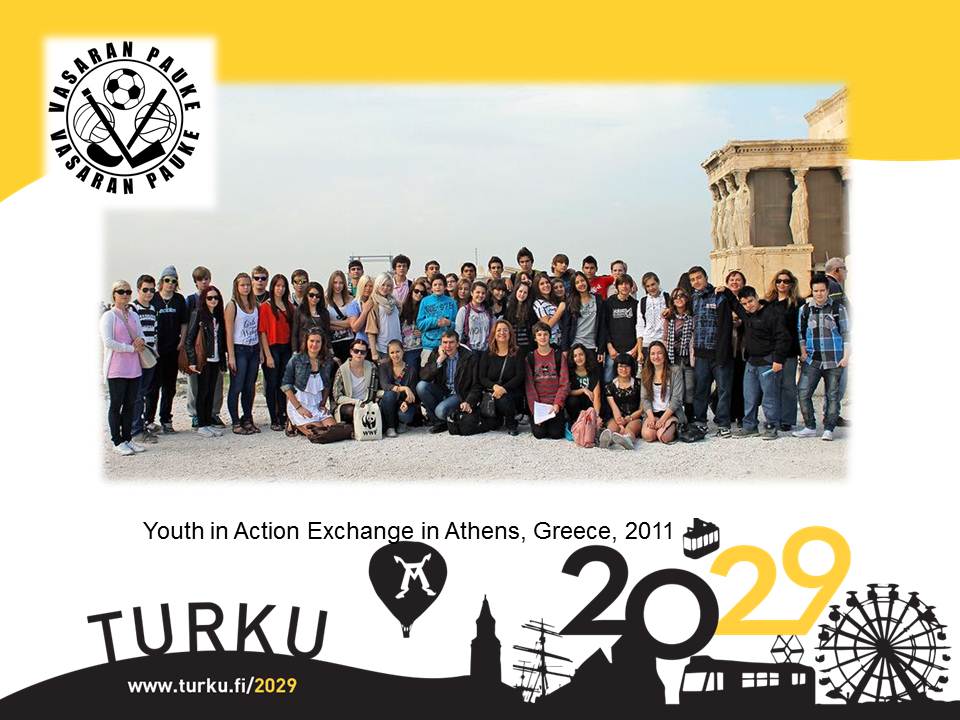
association we have been involved in the Youth in Action program–activities.
We organized an exchange in Athens with a Greek
youth
group
called Human City
in November 2011.
I
am grateful for that project for many reasons. Biggest achievement is that the student group really understands better than most Finnish people do what the situation is like and what kind of challenges ordinary Greek people meet now.

I
have
participated in several Youth in Action –training courses.
These courses have really inspired me
in my profession, because I really think that we need methods of non –formal learning
in completing
formal education in order to avoid drop out and early school leaving among our students.
What is actually difference between formal and non-formal learning?
I have
found
that
we
here
in the north use a lot of methods which in some other countries are seen as methods of non-formal learning and
seen
as extra-curricular activities.
It means that it has been difficult to us organize for example
exchange for pupils during the school days, because the day offs from formal education are not possible in
the partner school.


We have had a lot of visitors during last ten years; from other European countries, Japan, South-Korea, South-Africa, Australia, New Zealand and USA.
That’s obviously because of Finland’s good results in PISA-program.
For
me people visiting our school gives an opportunity to a self-evaluation and to evaluate the school. Visitors’ questions and thinking out loud
help me in that.


I
can
still
remember the time when we at our school could decide weather we are international or
not
and when
would
we
like
to pick
it up
like
a topic
to study. But times have changed now and every community, school and work place is international.
Internalization and multiculturalization are really
present in
today’s school,
so in Vasaramäki School
too.
Internationalization
at home in this
context means that we have a big number of pupils whose roots are somewhere else other than in Finland.
These pupils and their parents are a resource that we haven’t utilized enough, yet. This is our challenge.


In
the
project, Story of Anni and Fadumo, we have intended to create equal and mutual co-operation with two
African schools during the past two years. This project was coordinated and
funded by the Finnish National Board and Ministry of Education.
So far we have produced a movie about Anni and Fadumo. Anni is 15 years old student in Vasaramäki School and Fadumo goes to school in the school of Tubluk in Somaliland.
The
film
is to foster global education in Finnish schools as well as in other
countries.
In
Finland many things are well and we consider them as granted. We also tend to
criticize things rather than appreciate them. This documentary
makes us think about the real values of life. During the
film making process the students’ awareness on humanitarian aspects grew
remarkably.

Our latest venture is a movie
project with Chepyuan Primary School in Mogotio, Kenya.
The
film
will
be
ready this year and it will
be
published through internet; You can find it
- as well as Story of Anni and Fadumo –
on our
school’s web site.
Presently I’m looking forward to creating
partnership project
with Chepyuan
Primary School about Life
skills, even if
the current
political and
economical situation in Finland doesn't encourage us to that.
This was my presentation in a workshop on Tuesday the 4th.


